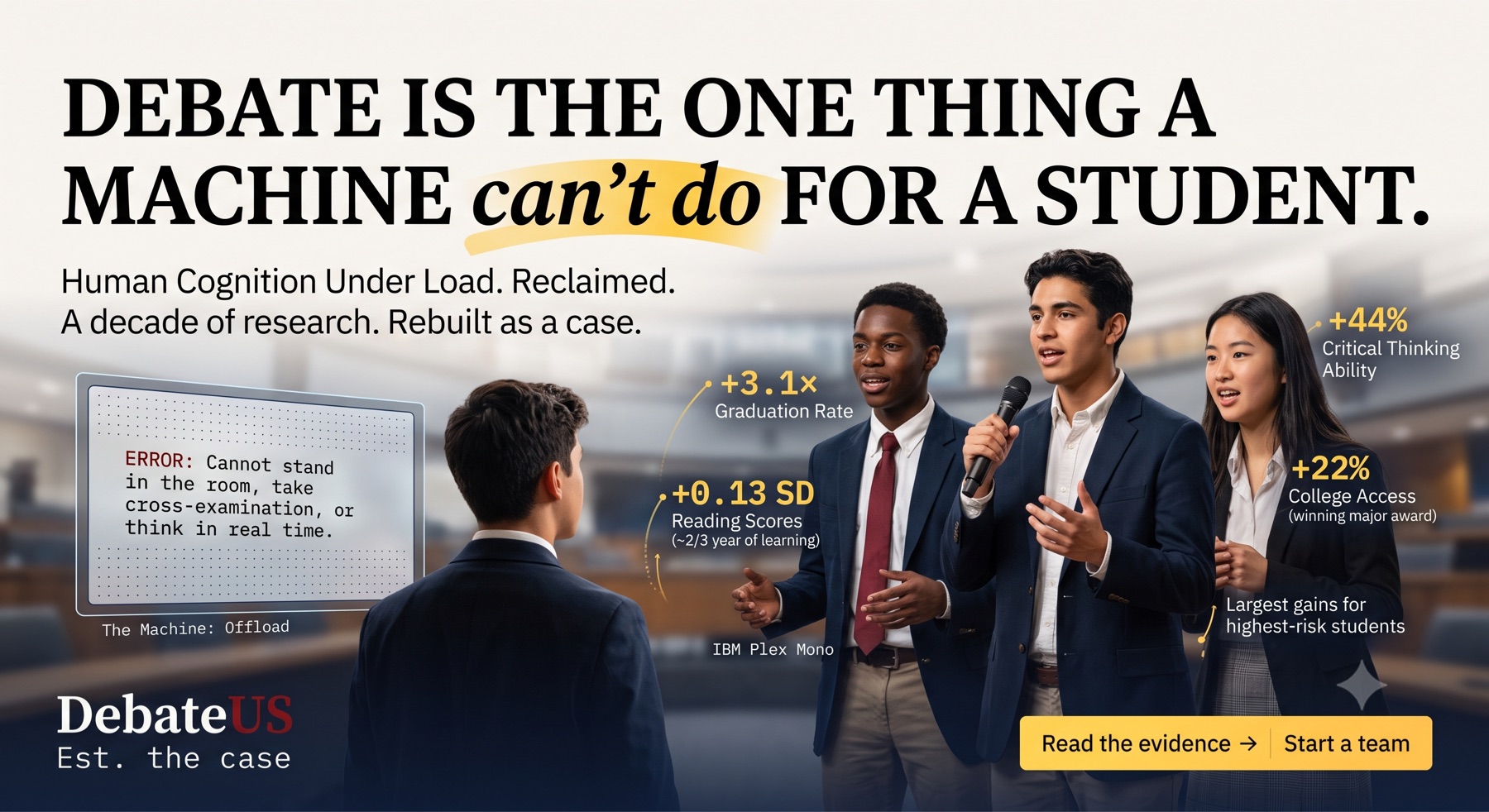
Chicago debaters were 3.1× more likely to graduate high school than matched peers. Among the highest-risk students, 72% of debaters graduated — against 43% who didn’t debate.

A student can ask AI to draft the speech. It cannot stand in the room, take the cross-examination, and think in real time against a live opponent. Four decades of practice and a decade of hard data point to the same verdict: the capacities debate builds are the ones that still belong to us.
It rests on administrative datasets tracking tens of thousands of students, longitudinal studies with real comparison groups, and meta-analysis across decades of research. Four findings, cut like the evidence a debater carries into a round.
Chicago debaters were 3.1× more likely to graduate high school than matched peers. Among the highest-risk students, 72% of debaters graduated — against 43% who didn’t debate.
In the years students are on a debate team, reading scores rise ~13% of a standard deviation — roughly two-thirds of a year of learning. Gains concentrate in analytical, not rote, skills.
A meta-analysis found communication and forensics training produces a 44% improvement in critical-thinking ability — with competitive debate showing the largest effect of any format studied.
Debaters improved their college-admission odds more than participants in any other activity studied. Winning a major debate award raised admission chances by at least 22%.
The most rigorous evidence for debate comes not from selective prep schools but from urban public districts, where administrative data let researchers control for who students were before they ever walked into a round.
In Chicago, a decade of records on more than 12,000 students found that debaters were 3.1 times more likely to graduate than comparable classmates. The effect was strongest exactly where schools struggle most: among the highest-risk students, roughly seven in ten debaters finished high school, compared with fewer than half of those who didn’t debate. African American male debaters were three times less likely to drop out, even after accounting for eighth-grade test scores and GPA.
Boston’s study, published in 2023, reached the same conclusion with a different method. Tracking students against themselves across years they did and didn’t debate, researchers found positive effects not only on achievement but on high school graduation and enrollment in college afterward. And the benefits followed dose: the more rounds a student debated, the larger the gains. This is not a program that skims off students already bound to succeed. It changes trajectories.
The arrival of AI that can write hasn’t made debate less relevant. It has revealed what debate was always for.
We built schooling around retrieval — find the fact, recall it, write it up — and then ranked children by who could retrieve fastest. AI is very good at that game. It is not good at the other thing: holding a contested question, weighing evidence on more than one side, and arriving at a defensible judgment under pressure, in public, with someone trying to break your reasoning in real time.
That is cognition under load — the only kind that is actually hard, and the reason competitive debate posts the largest critical-thinking gains of any communication format ever studied. It is also why debate is the assessment AI can’t fake: we may not know what a student wrote versus what a machine wrote, but we know exactly what they said, on their feet, when the questions came. As assessment shifts from what students submit to what they can actually do, debate is the format that survives contact with the machine. The fuller argument runs across Stefan Bauschard’s Education Disrupted and the peer-reviewed work on debate as learning assessment in the AI world.
Across dozens of essays, Stefan Bauschard has gathered the argument into a single guide and a single claim: in the age of AI, debate is the fourth literacy — as fundamental now as the three Rs were to the industrial age. Here are the ten reasons, in brief.
Debate is how humans rehearse staying in charge of choices that matter.Read the full guide →
Most interventions that raise achievement help the students who were already ahead. Debate does the opposite — and that is its rarest property.
In Boston, the reading gains were largest for the students who started with the lowest elementary-school scores. In Chicago, the graduation effect was greatest for the highest-risk students. Researchers were blunt about how unusual this is: few interventions reduce inequality in reading achievement among adolescents at all, let alone in the higher-order reasoning skills that standardized curricula rarely touch.
The mechanism is not mysterious. Debate makes students read closely because they need the best evidence to win. It rewards the academic language and analytical reasoning that reading tests measure. And it does this inside a structure — a team, a coach, a season, a reason to show up — that keeps students engaged with school itself. The competition is the motivation; the learning is the result.
The doors open early. Debaters clear ACT and SAT college-readiness benchmarks at higher rates than their peers, with the strongest effects on the reading and English sections — and they carry a measurable edge into admissions itself.
One analysis found that simply participating in debate improved a student’s admission odds more than any other extracurricular activity; winning a major award raised them by at least 22%. Boston’s data extends the story past the acceptance letter, linking debate to higher rates of actually enrolling in college.
Sometimes the door opens all the way. Ashley Adirika, a first-generation Nigerian-American recruited to her Miami middle-school debate team in eighth grade, applied to all eight Ivy League schools in 2022 — and got into every one of them, along with seven other universities. She credits debate with the confidence to make her voice heard, and chose Harvard to study government and policy.
The advantage compounds in working life. Warren Buffett has told young professionals that learning to speak well can raise their value by half, and recruiters keep rediscovering that the people who can frame an argument and hold a room are the ones who end up leading it. Debate is where that begins.
And the doors keep opening for decades. Ketanji Brown Jackson was a standout on her high school debate team; it was at a tournament held at Harvard that she first believed she could study there — refusing the limits others tried to set for her. The composure the country watched at her confirmation hearings was a skill she first built at a lectern, on a clock, taking questions.
We are sorting ourselves into like-minded corners and losing the muscle for disagreement. In one poll of young Americans, most partisans said they wouldn’t even go on a first date with someone who voted for the other party — a startling measure of how far apart we’ve drifted.
Debate builds the opposite habit. Two students are handed a proposition and assigned a side at random; each gets equal time; an impartial judge decides who was more persuasive. It is a shared method for settling a dispute with reasons instead of volume — and because the sides are assigned, a debater regularly has to build the strongest version of the argument they walked in rejecting. You cannot caricature the other side when you have to defend it next round.
Out of that discipline comes a portable toolkit. As two-time world champion Bo Seo argues, debaters learn to carry four questions into any disagreement — and to judge whether an argument is even worth having:
They learn to argue hard one minute and shake hands the next. This is not a nicety. From the Athenian assembly debating the fate of Mytilene to Lincoln and Douglas on the prairie, free societies have used structured argument to decide hard questions in public — and some scholars go further, treating debate as a tool for defusing the dehumanization that precedes atrocity. In a moment when the alternative to arguing is often not agreement but refusing to speak at all, teaching a generation to disagree well may be one of the surer repairs we have.
Ask who learned to think this way and the list runs from the bench to the stage to the C-suite. As chronicled by champion debater Bo Seo in The Wall Street Journal and by Axios, they share one line on the résumé.
“The power of words to influence ideas, to change minds.”
These aren’t people who happened to debate. Presidents, justices, and CEOs are disproportionately debaters — because the activity trains the one thing every one of those jobs demands: making a case, under pressure, to people who can say no.
Everything behind the case above — the causal studies, meta-analyses, league evaluations, reports, and essays — organized by what it measures. For coaches making the argument to a principal, and skeptics who’d rather read the source.
Debaters were 3.1× more likely to graduate (95% CI 2.7–3.5); among the highest-risk students, 72% of debaters graduated versus 43% of non-debaters, and more rounds predicted higher completion.
African American male debaters were 70% more likely to graduate and three times less likely to drop out than non-participants, even after controlling for 8th-grade test scores and GPA.
The largest debate evaluation at the time; with propensity-score matching, debaters graduated more often, scored ~1 point higher on the ACT, and posted higher GPAs (3.23 vs. 2.83).
School, social, and civic engagement were higher among debaters, but only partly explained the academic effects; even low-competitive-success debaters were likelier to graduate and hit ACT benchmarks.
Across 35,788 students in a predominantly Latino district, propensity-adjusted debate participation was associated with +0.66 GPA, +52 SAT Math, and +57 SAT Reading/Writing.
The federal evidence review rates Urban Debate Leagues “Promising,” citing statistically significant effects on graduation and ACT-indicated college readiness.
Using a within-student design, reading rose 0.13 SD (≈68% of a year of 9th-grade learning), concentrated in analytical skills, largest for the lowest starters — with no harm to math, attendance, or discipline.
A mixed-methods study of 179 middle-school debaters finds debate builds academic reading comprehension alongside critical literacy, perspective-taking, and civic identity.
Participants gained ~14% growth — about 4.4 points above expected — on the MCA Reading test, and female urban debaters exceeded national reading norms.
Frames debate as a corrective for the language-development gaps that disproportionately affect Black youth and shape academic trajectories.
Communication and forensics instruction produces a 44% improvement in critical-thinking ability (Binomial Effect Size Display), with competitive forensics showing the largest effect of any format.
The landmark synthesis arguing competitive debate builds critical thinking, academic achievement, and pro-social conflict resolution; makes the case for Debate Across the Curriculum.
Debate participants score higher on standardized critical-thinking tests and show increased constructive argumentativeness — without increased verbal aggression — relative to controls.
A widely cited demonstration that in-class debate cultivates active learning, critical thinking, and oral-communication skills in higher education.
Debate improved admission odds more than any other activity studied: state/national award winners saw 22–30% higher acceptance at top colleges, and team captains 60%+.
Debaters matriculated to college — especially four-year institutions — at higher rates, an effect largely mediated by their stronger ACT performance.
From similar 8th-grade baselines, forensics students made larger gains than matched Honors-English non-forensics peers on state tests and earned higher ACT scores — ruling out simple self-selection.
About 80% of debaters graduate high school in five years vs. 68% of non-debaters, and ~53% enroll in college within two years vs. 41% — driven mainly by four-year enrollment.
In an 18-month randomized field experiment at a Fortune 100 firm (N=471), a nine-week debate course made employees more likely to advance in leadership — mediated by assertiveness. A second experiment (N=975) replicated it, consistent across gender, ethnicity, and birthplace.
A longitudinal survey of elite college debaters documenting disproportionate later attainment of advanced degrees and professional success.
Warren Buffett tells young professionals that mastering communication can raise their value by ~50% — the persuasion skill debate builds directly.
Argues debate builds the presentation, persuasion, and audience-connection skills employers increasingly prize.
In a nationally representative sample, adolescent debaters were significantly more likely to volunteer and — into early adulthood — to join civic and political organizations, take non-electoral political action, and register to vote, controlling for gender and class.
Argues broad debate access builds the reasoning, evidence-evaluation, and cross-partisan listening a healthy democracy needs.
“America in One Room”: structured deliberation measurably reduced affective polarization and moved participants toward more considered, less extreme positions.
Finds classroom debate and deliberation can reduce partisan division among high-school students under supportive conditions.
Argue debate instruction is an antidote to rising polarization and the overvaluing of consensus.
20 leagues in 20 cities reach roughly 10,000 students a year; aggregates evidence that UDLs disproportionately benefit low-income students and students of color.
Documents debate’s specific benefits for at-risk young women in urban communities, including higher ELA scores and GPAs.
An ethnography of how urban debate cultivates academic identities and evaluative skills among marginalized students.
After one UDL year, debaters improved attendance and GPA (~10%), reduced risky behaviors, and gained ~25% in literacy versus a non-debating control group.
“‘I Was Gone on Debating'”: Malcolm X’s prison debate experience, a foundational case in the debate-as-empowerment literature.
The first international research synthesis; concludes debate develops literacy, critical thinking, confidence, and communication — while candidly calling for more rigorous study.
Founded in 2012 as a reconciliation and genocide-prevention tool, teaching youth to disagree without treating opponents as enemies through leagues and a leadership academy.
Argues debate is a global tool for civic renewal and genocide prevention; documents U.S. coaches training ~250 Rwandan students.
Documents debate’s spread and its benefits for English-language learners across the U.S. and abroad.
Cross-cultural debate builds English fluency and global readiness for students preparing to study abroad.
Among psychiatry residents, debate promoted critical thinking, deeper understanding, self-directed research, and higher engagement.
Structured student debates improved second-year medical students’ critical-thinking and informatics skills.
Ethical debates enhance critical thinking in nursing education — a finding widely replicated across the nursing pedagogy literature.
A debate series raised quiz grades up to 36% and shifted opinions up to 31%, with higher self-rated critical thinking, communication, and teamwork.
Debate-centered course design fostered higher-order thinking and engagement in a critical-care pharmacy elective.
Institutional adoption of debate as a cross-disciplinary pedagogy building critical thinking, research, oral communication, collaboration, and empathy.
The first quantitative study of preadolescent debate; using doubly-robust IPTW on a 10-year sample, debate raised 8th-grade reading and math scores, cut chronic absenteeism, and raised the odds of attending a selective-entrance high school.
“Passport to the Future”: a university–high-school debate mentoring program in a racially segregated New Jersey school boosted academic outcomes and citizenship.
Coverage of Hilton Elementary debaters preparing for a city championship, illustrating early-grade engagement.
A developmentally-tailored three-student parliamentary format designed to maximize participation and learning.
An ethnography of high-school debate concluding a well-designed program nurtures the intellect while helping teens make better behavioral choices.
Frames competitive debate as a scalable vehicle for building non-cognitive skills — grit and growth mindset — including in low-resource urban schools.
High-school students report that debate builds confidence, communication, and self-efficacy.
A two-time world champion argues debate builds the confidence and comfort with disagreement that underpin leadership.
The single resource that gathers this entire body of work — ten reasons debate is essential in an AI world, the Universal Basic Debate thesis, and links to every essay below. Start here.
Argues argumentation is the “fourth literacy” (the fourth R) for the age of superintelligence, and that every student should have the chance to build and defend arguments.
Reframes debate not as an extracurricular but as essential infrastructure for keeping human judgment scaling alongside machine intelligence.
Argues debate is AI-resistant assessment: AI can help prepare, but can’t take cross-examination, synthesize live, or deliver the closing — so debate verifies authentic human learning.
A peer-reviewed research agenda for responsible AI integration in education, built around debate-centered instruction.
A structured framework for teaching AI-era argumentation in the classroom.
On fostering human deep learning and amplifying intelligence in an AI era.
The book-length argument that debate can revolutionize education and help save our democracy.
Notes four sitting Supreme Court justices (including Ketanji Brown Jackson), Bruce Springsteen, Oprah Winfrey, Jack Dorsey, and Indra Nooyi among debate and speech alumni.
Credits his four years in debate as “the educational foundation of everything I did” and most of the intellectual capacity he still uses.
A National Forensic League survey found 64% of members of Congress competed in debate or speech; the NSDA counts roughly two million living alumni.
Journalistic pieces on debate’s transformative impact — from a first-generation debater admitted to all eight Ivies to Denzel Washington’s $1M gift to Wiley College’s team.
“Debating for Success”: links Milwaukee Urban Debate League participation to achievement, self-efficacy, and civic empowerment.
“Pedagogical Possibilities for Argumentative Agency”: the foundational theoretical text on debate as a vehicle for student empowerment.
A compiled reading list on competitive academic debate as a tool of empowerment for urban America.
Compilations of peer-reviewed sources on debate’s educational benefits — useful starting points for deeper reading.
The strongest causal evidence comes from studies that control for self-selection — stronger students tend to choose debate. The Boston within-student design, the Chicago and Houston propensity-score analyses, and the MIT workplace randomized trial all do this; their adjusted figures are the defensible ones to cite.
Most Urban Debate League studies are quasi-experimental rather than randomized, and several higher-education and social-emotional findings rely on self-report and smaller samples. Where a claim is associational, it reads “is associated with,” not “causes.”
One pattern holds across the most rigorous work: debate’s benefits are largest for the students who start furthest behind — the finding that makes debate unusual among education interventions, and the strongest reason to expand access.
Whether you’re starting a team from nothing or making debate central to how your classroom works, the next step is the same: get students on their feet, thinking in real time. We’ll help you do it.