

he November/December Lincoln-Douglas topic is Resolved: De-extinction is unethical. It won the NSDA vote with 54 percent of coaches and 57 percent of students, so you’ll be living with it for two months.
The resolution reaches into a lot of ethics: animal welfare, ecological risk, the value of species and wild nature, who decides what happens to ecosystems, and what people owe the species they drove extinct. It also starts with a definitional problem, because nothing extinct has come back. What scientists can make today are proxies, animals cloned, bred, or edited from a living relative to carry some traits of a lost species.
Where the science stands
There are three basic methods: back-breeding living animals for ancestral traits, cloning from preserved cells, and editing a close relative’s genes. Colossal Biosciences gets most of the headlines, but nonprofits such as Revive & Restore and other research groups work with the same tools.
The famous projects are still early. Colossal’s 2025 “dire wolves” are gray wolves with 20 gene edits, and the IUCN Canid Specialist Group concluded they are neither dire wolves nor valid proxies. Its target for a mammoth-like calf has slipped from 2028 to the early 2030s (TIME), and bird projects such as the dodo and New Zealand’s moa face harder biology.
The clearest successes involve endangered species, not extinct ones. Cloned black-footed ferrets, made to restore genetic diversity the species had lost, have bred, though two of the three clones died in 2025 (Smithsonian). Researchers trying to save the northern white rhino had created 39 embryos by April 2026 but had no lasting pregnancy (Leibniz Institute).
Beyond the lab
Conservationists are divided. In October 2025 IUCN members adopted a case-by-case policy on synthetic biology and rejected a moratorium on genetically engineering wild species by a single vote (Conservation Letters).
Governments are getting involved. In April 2025 US Interior Secretary Doug Burgum cited de-extinction while criticizing the endangered species list (Inside Climate News), and in June 2026 the Fish and Wildlife Service agreed to build a genomic and tissue archive with Colossal for more than 2,300 listed species.
Money and ownership raise their own questions. Most of the field is privately funded, Colossal bought the pet-cloning company ViaGen in 2025, and projects like the moa raise the question of who gets to decide what returns to Indigenous lands.
The affirmative
The affirmative has several lines of attack, and a good case develops two or three. Start with welfare: making proxies puts surrogate mothers and their offspring through experimental cloning and gene editing, for benefits that are years away or available some other way.
Ecology gives the affirmative another line. A proxy enters an ecosystem that has changed since its ancestor vanished, and releasing an engineered animal is hard to predict and harder to undo. Big environmental promises often shrink under scrutiny; a 2020 modeling study of using large grazers to protect Arctic permafrost found it would take an unrealistic scale to matter for the climate.
Then there’s cost. A study in Nature Ecology & Evolution found that in New Zealand, managing 11 revived species could cost conservation for about 31 living ones. The moral-hazard version adds that resurrection becomes an excuse to protect less, and affirmatives will point to the Endangered Species Act’s regulatory definition of “harm,” rescinded in September, though nobody has shown de-extinction caused that.
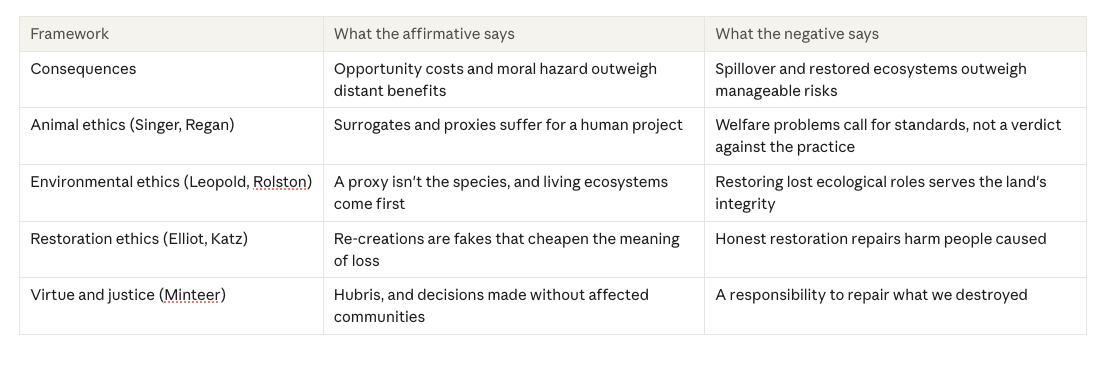
Finally, there’s principle. Calling gene-edited wolves “dire wolves” misleads the public, a few companies are deciding the future of ecosystems and communities without their consent, and philosophers from Robert Elliot (“Faking Nature”) to Ben Minteer (Nature) argue that re-created nature lacks the value of the original or feeds a dangerous hubris.
The negative
The negative’s strongest ground is repair. People caused most recent extinctions, which gives us reasons to restore lost species and the roles they played in their ecosystems when it can be done responsibly. Even Minteer lays out this justice argument before arguing for restraint.
Its best evidence is spillover. The same tools already help living species, from cloned ferrets to the new federal biobank, and research aimed at extinct animals keeps producing reproductive and genetic techniques that conservation can use.
The money fight is closer than affirmatives admit. Much of the funding comes from private investors who would never have paid for conventional conservation, and the authors of the opportunity-cost study noted that resurrection paid for entirely with outside money could help living species.
Then argue proportion. Every harm on the affirmative’s list is a reason for rules, oversight, and consent, which is the route the IUCN chose, and none of it shows the practice is wrong in itself. Honest proxies don’t fool anyone, and some projects, like the moa partnership with the Ngāi Tahu Research Centre, involve Indigenous partners from the start.
Framework
Settle what the resolution means early. “De-extinction is unethical” is a general claim, so affirmatives usually argue the practice is wrong in principle or as it is actually being done, while negatives argue it can be ethical under the right conditions. You’ll also need to decide whether the round is about resurrecting species or making proxies, because that choice decides which evidence counts.
After that, most rounds turn on the counterfactual: what happens to animals, money, attention, and political will with de-extinction, compared with a world without it? The framework decides how those facts get weighed.
Before your first round
Never say anything “is back.” Describe what was actually made.
Say what kind of source you’re reading. A lot of the field’s biggest news comes from company press releases and preprints, and a good opponent will ask whether there’s a paper behind it.
Read the opportunity-cost study closely before you run it. Its result depends on who pays for long-term management.
And watch for new announcements. Companies and research groups report milestones often, and any one of them can change your evidence.
Everything here comes from our full handbook, which has sixteen chapters, framework options, case outlines, answer tables, crossfire questions, a timeline, a glossary, and 94 annotated sources.