

Download this here —
The November/December Public Forum resolution asks whether European members of NATO should ratify the Treaty on the Prohibition of Nuclear Weapons. At bottom, it asks whether nuclear weapons make Europe safer or more dangerous.
The topic pulls in a lot: what the treaty requires, how it fits with NATO and the Nuclear Non-Proliferation Treaty, what a nuclear war would do, whether Europe can still count on Washington, and how Russia changes the picture. The teams that win will connect those pieces instead of camping in one of them.
What ratifying would actually do
The treaty bans making, testing, holding, hosting, using, or threatening to use nuclear weapons. It also bans helping anyone else do those things. Seventy-five countries have joined (Tonga became the 75th this year), and none of them is in NATO. When the treaty was adopted in 2017, the Netherlands cast the only no vote.
For Europe, joining would have real consequences. Belgium, Germany, Italy, the Netherlands, and Türkiye host about 100 American B61 bombs, and under deadlines the treaty’s members set in 2022, a host country gets 90 days to send them home. France and Britain would have 10 years, with a possible five-year extension, to give up their arsenals. The ban on helping with nuclear use would also shut down the aircraft and exercises behind NATO’s nuclear sharing, although lawyers disagree about how far it reaches into alliance planning.
Don’t expect it soon. Belgium, Germany, and Norway used to send observers to treaty meetings, and in 2025 they stayed home.
Why 2026 raises the stakes
Arms control is coming apart. New START, the last treaty limiting US and Russian strategic forces, expired in February, and the NPT review conference failed in May for the third time in a row. The Doomsday Clock sits at 85 seconds to midnight, the closest it has ever been.
Russia is the main reason European governments lean on deterrence. It holds about 4,400 nuclear warheads, has lowered its threshold for using them, and keeps probing NATO with drones, sabotage, and cyberattacks. In September, Danish military intelligence warned of a growing risk of a limited Russian attack on a NATO neighbor.
The alliance is shifting too. The 2026 US defense strategy tells Europe to lead its own conventional defense while America keeps the nuclear umbrella, and France has begun offering Europe a nuclear role of its own, announcing its first warhead increase since 1992.
The pro case
The pro’s core claim is that deterrence is a bet that has to pay off every time. A 2022 study in Nature Food estimated that more than 5 billion people could die of famine after a US–Russia nuclear war, and Princeton’s Plan A simulation, which begins with nuclear use in Europe, projects more than 90 million dead and injured in the first few hours. With arms control collapsing, the bet keeps getting worse.
The treaty is also the pro’s answer to a stalled disarmament process. NPT members promised in 1968 to pursue nuclear disarmament, supporters say the ban finally turns that promise into law, and three failed review conferences in a row suggest the old route isn’t working.
On security, the pro has more than people expect. Matthew Fuhrmann and Todd Sechser found that alliance commitments deter attacks, while basing nuclear weapons on an ally’s soil adds nothing measurable (2014), so Europe could send the bombs home and keep the alliance. Most of what Russia is doing to Europe happens below the nuclear threshold anyway. And nuclear blackmail rarely works: across more than 200 coercive threats, nuclear-armed states did no better than anyone else (Sechser and Fuhrmann, 2017).
The pro can also argue from norms and democracy. Bans can stigmatize a weapon well beyond their members, as Norway’s wealth fund shows by excluding several nuclear-weapons makers, and recent polls find majorities in Germany and Italy opposed to hosting American bombs.
The con case
The con’s core claim is that Europe would be disarming alone. No nuclear-armed state has joined, Russia rejects the treaty outright, and ratification would send the American bombs home while Russia keeps roughly 1,800 weapons built for regional use. Robert Rauchhaus found that wars are more likely when only one side of a rivalry has nuclear weapons, and intelligence services expect the danger from Russia to grow over the next two to five years.
The alliance is the con’s second front. NATO says the treaty conflicts with its deterrence policy, Norway’s 2018 review found that joining would clash with its NATO obligations, and the first Trump administration called ratification “a strategic error.” If Washington walks away, Bruegel estimates Europe would need about 300,000 more troops and 250 billion euros a year to fill the gap.
The con can also attack the treaty itself. It relies on existing IAEA safeguards instead of stronger inspections, and it leaves verifying disarmament to an international authority that hadn’t been designated when its deadlines were set. Because the resolution covers France and Britain, it would also end the European deterrent Macron is building, and it could push frontline states like Poland, whose leaders talk about their own nuclear potential, toward building bombs.
Where rounds are won
Most rounds come down to a handful of clashes.
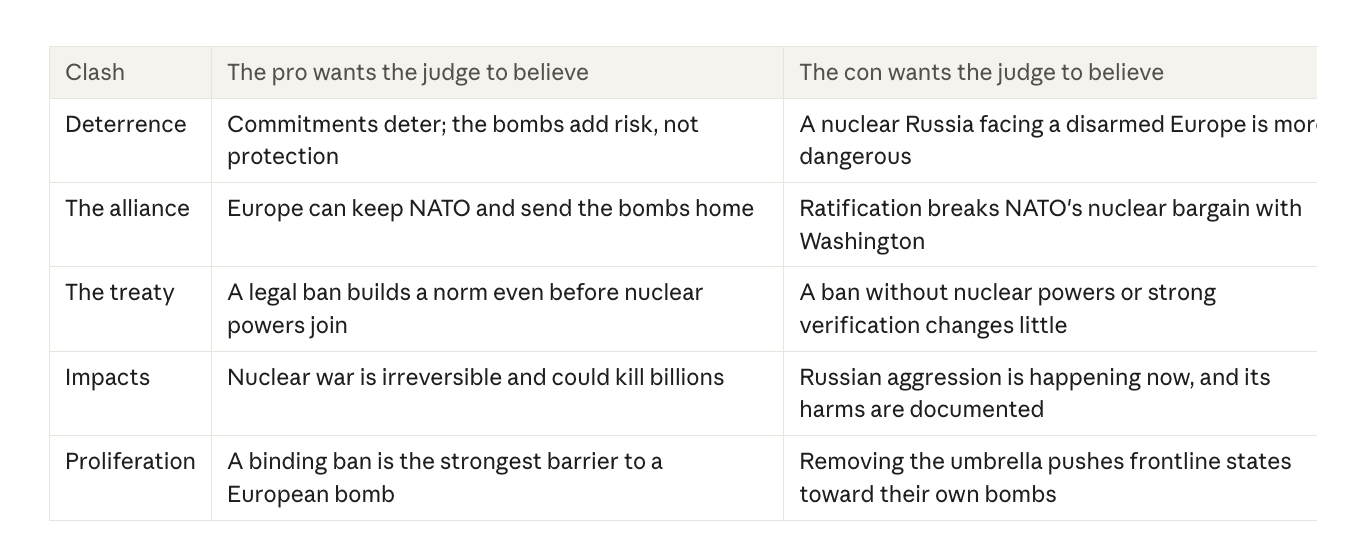
On impacts, the pro weighs magnitude and the con weighs probability. The con’s strongest card is a March 2026 UN Commission of Inquiry finding that Russia’s deportation of Ukrainian children amounts to crimes against humanity. It can also point out that the famine studies assume a US–Russia war that European ratification wouldn’t prevent.
A few tips
Lay judges want concrete examples. The 90-day deadline, the B61s at Belgium’s Kleine Brogel base, or a drone over Poland will land better than deterrence theory.
Tell the judge who your sources are. ICAN, NATO, and government ministries are all advocates, and a good opponent will say so if you don’t.
Watch the calendar. NATO’s Steadfast Noon exercise usually runs in October, and the treaty’s first review conference meets in New York from November 30 to December 4. Either one could hand you new evidence in the middle of the topic.
If you want the evidence behind all of this, our full handbook runs 68 pages, with 218 annotated sources, case outlines, answer tables, and crossfire questions.