

Where this comes from
Everything below comes out of a few local tournaments in the first weekends of the topic. That is a small sample. Early local rounds surface the arguments teams had ready on day one, not the arguments the topic will eventually produce.
That changes next weekend. The Harvard Debate Union Season Opener is a larger field, and the UK Season Debate Opener runs online the same weekend with Grapevine live, which are both massive fields, alongside another round of local tournaments. Expect an explosion of arguments out of that weekend. Read this as a snapshot of the opening position, not a map of the topic.
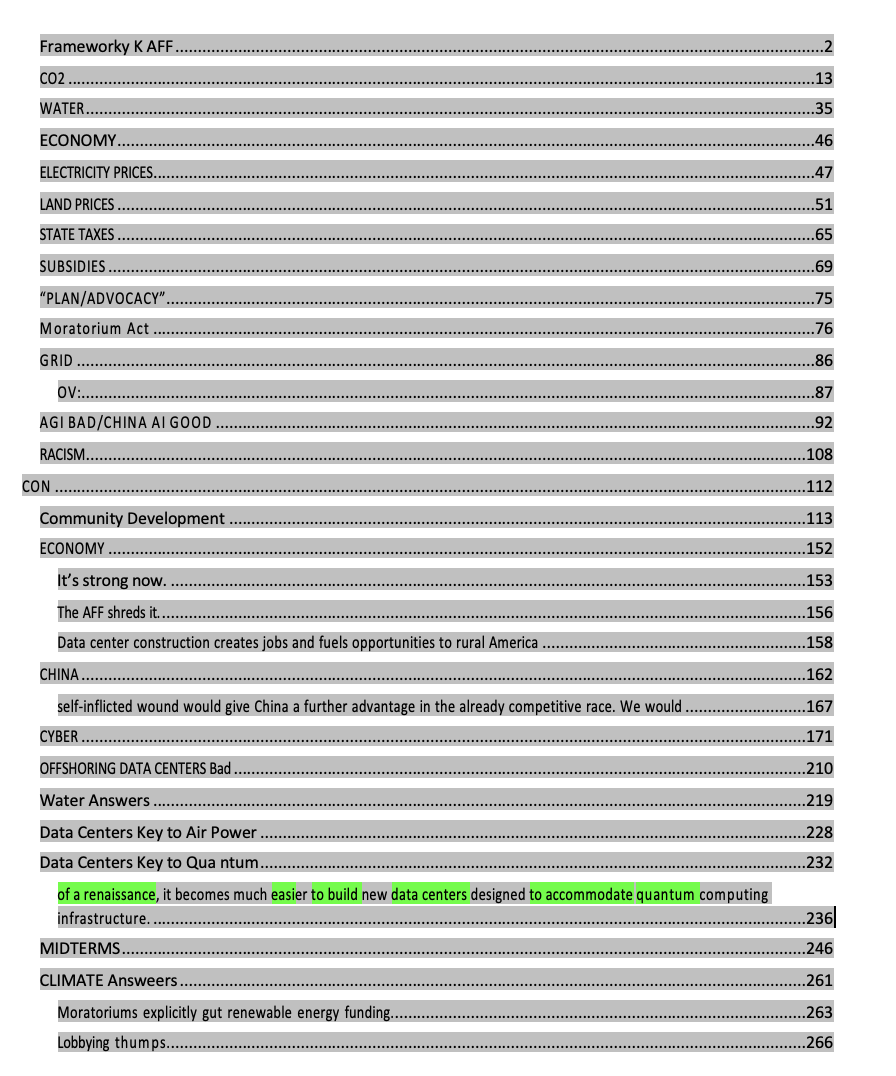
We do have this all organized in one document here --
The bill everyone references
Almost every round runs through one piece of legislation, so start there.
S.4214, the Artificial Intelligence Data Center Moratorium Act, was introduced by Sen. Bernie Sanders on March 25, 2026. Rep. Alexandria Ocasio-Cortez introduced the House companion, H.R. 9442, in June with nine cosponsors. It halts construction and upgrades of covered AI data centers until Congress enacts safeguards and expressly terminates the moratorium.
The structure of that bill decides more rounds than any impact card in the file.
It is conditional, not timed. Most affirmatives read a land-use attorney's explainer defining a moratorium as a temporary suspension, typically a year or less, while a jurisdiction writes rules. That definition converts the resolution from "ban AI" into "pause and regulate," and it defuses most of the negative's economy and China offense. Negatives who let it stand have lost the framing. The answer is that S.4214 has no sunset. It runs until Congress acts on AI, and Congress has not acted on AI in three years.
The second definitional gap is "hyperscale." The resolution does not define it. Real policies use different thresholds: 50 MW in New York's executive order, 20 MW in the New York legislature's bill, 40 MW average capacity in the Harvard study of 403 U.S. facilities that both sides cut. A pro that defines hyperscale narrowly, at the 5 GW campus scale, dodges most of the jobs offense. A con that defines it broadly picks up the entire cloud economy.
The third question is whether the affirmative is the bill or the resolution. Teams are having it both ways, reading a plan block that mirrors S.4214 and then retreating to the general resolution when the bill's conditionality hurts. Force the choice. If the aff is S.4214, it inherits the conditionality. If the aff is the bare resolution, it cannot solve for utility rate classes, subsidy repeal, or community benefit agreements, because none of those things is a moratorium.
Two other pieces of context show up constantly. On July 14, 2026, Gov. Kathy Hochul signed Executive Order 62, making New York the first state with a statewide moratorium: a one-year pause on discretionary state environmental permits at 50 MW and above, paired with a directive to build a regulatory framework during the pause. Texas followed with restrictions on new grid interconnections. And more than 500 local jurisdictions have adopted bans or moratoria. Debaters are arguing about whether to nationalize a policy that is already running.
The Pro
Affirmative files split into two families. Most teams read a resource-and-ratepayer case. A smaller number read an AI-risk case, and those rounds go somewhere very different.
1. Ratepayer cost-shift
The strongest pro argument and the one with the most durable evidence. The mechanism requires no speculation about AI at all. A utility builds generation and transmission to serve a new large load. Those capital costs enter the rate base. Every residential customer pays for infrastructure built to serve a handful of very large corporate customers.
The Harvard Electricity Law Initiative paper makes the argument in its sharpest form. The Consumer Reports investigation gives the retail version: residential prices up 7.1 percent in 2025, more than double inflation, above 20 percent in some states, with Bloomberg's analysis finding much steeper increases in data-center-heavy areas. New York's executive order cites state residential electricity prices up nearly 68 percent since 2019.
This wins because a lay judge understands it in one sentence and every negative answer is structural rather than empirical. It also extends cleanly through the energy burden literature on how unaffordable utility bills produce debt, cold homes, and health harm. That gets you a body count without an extinction card.
2. Grid strain and reliability
Related but separate. Load is being added faster than generation and transmission can be built. Affirmatives cite EIA's AEO2026 projection of server electricity consumption growing across the commercial building stock, and Bloom Energy's projection that total U.S. data center demand roughly doubles from 80 to 150 GW between 2025 and 2028. NYISO's interconnection queue holds close to 12 GW of data center load requests.
The link is strong. The impact is not. The blackout cards in circulation come from thin sources, including one heavily read card from a solar marketing site. Negatives who read source qualifications out loud win the reliability debate on evidence quality alone. Better material exists directly from NYISO and PJM. I expect these cards to be replaced within two weeks.
3. Emissions and fossil lock-in
The version that survives is lock-in, not generic warming. MIT Technology Review's reporting on Entergy's Louisiana plants shows utilities building gas capacity with 30-year lifetimes to serve a load that may not persist for 30 years, committing the grid to fossil generation past the point where cleaner options mature. Rhodium estimates an additional 278 million metric tons of annual U.S. carbon emissions by 2035 under high demand and cheap gas. The Harvard hyperscale study adds that hyperscale facilities ran roughly 60 percent on fossil fuels and exceeded national average carbon intensity by 52 percent.
Generic warming loses to the IEA evidence described below. Lock-in does not.
4. Water
The UNU-INWEH report anchors this and it is strong work. Its central claim is that the footprint is mismeasured, because carbon, water, and land footprints move independently. Switching from coal to bioenergy can cut the carbon footprint 70 percent while multiplying the water footprint thirtyfold. Projected global data center electricity demand of 945 TWh by 2030 carries an associated water footprint of 9.3 trillion liters.
The card that lands with judges is the Guardian analysis finding 517 of 809 planned U.S. facilities sited in areas that spent the past year in drought. It converts an aggregate number into a siting decision.
The best water evidence on the topic is barely being read. "Small Bottle, Big Pipe" argues from peak capacity rather than annual volume. Municipal systems cannot supply the peak withdrawals data centers need on the hottest days. That forces operators into dry cooling, which raises electricity demand, which stresses the grid during the same summer peak. That is far harder to answer than "they use a lot of water," and it hands the affirmative a second grid link.